Glare from PV systems on railways
On railway lines, the concern is train drivers, who must reliably recognise the line and the signals. A reflection can cause glare or outshine a signal if it comes from the same direction. Signals, level crossings, platforms and areas where trains run on sight are particularly relevant. For points along the track, PV-GlareCheck calculates when reflections lie within the field of view, how close to the viewing direction and how bright.
Guidelines
Germany. The sources evaluated contain no requirements of their own for railways. The position paper of the Federal Highway Authority (FBA, as of November 2025) applies to federal trunk roads; its criteria describe glare for a driver looking in the direction of travel and can be applied by analogy. Whether this applies in the individual case is decided by the responsible expert and the competent body.
Austria. OVE R 11-3 names glare in rail traffic at signals and level crossings as not permitted; in case of doubt, the guideline calls for a railway expert to be consulted. The guideline has been formally withdrawn and is unofficially often still applied for orientation.
What PV-GlareCheck calculates
- every minute of the year, under clear sky,
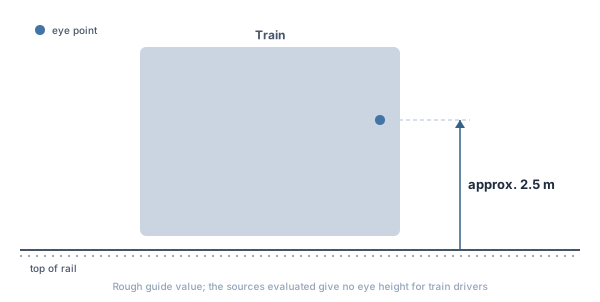
- observation points along the track per direction of travel, with a field of view in the direction of travel and a freely selectable eye height,
- separate points in front of signals with the viewing direction towards the signal,
- distance of the reflection from the line of sight, luminance and illuminance at the eye,
- duration and time periods of reflections per point,
- occlusion by recorded noise barriers, cuttings and structures and by the terrain.

Workflow
- Enter the system and the track on the map; points along a line per direction of travel, denser in front of signals and level crossings.
- On embankments, bridges and in cuttings, check the height of the top of rail and set it manually if necessary.
- Run the annual simulation with a module type with a measured reflection profile.
- Set the filters in the report and export the result as a PDF.
Limits
The simulation is a model-based screening and does not replace an expert report. Each observation point is stationary. Cab windows and sun protection are not modelled. The app does not assess whether a reflection impairs a signal aspect; it provides direction and intensity.
Next: Settings and filters are described in the manual, chapter VI.3 Rail traffic.
Sources
- Fernstraßen-Bundesamt (FBA, Federal Highway Authority): Eckpunktepapier Photovoltaik – Blendwirkungen und Blendgutachten. As of November 2025.
- OVE Österreichischer Verband für Elektrotechnik: OVE-Richtlinie R 11-3, Blendung durch Photovoltaikanlagen. Edition 2016-11-01, Vienna. Formally withdrawn on 1 Dec 2024 (OVE Standardization News 1/2025, p. 1), unofficially still often used for orientation.