Glare from PV systems on residents
Reflections from a photovoltaic system can reach living and working rooms, balconies and terraces in the neighbourhood. For residents, what matters is how often and for how long this happens. PV-GlareCheck calculates this duration for every observation point over a full year and provides the results as a basis for the expert assessment.
Guidelines
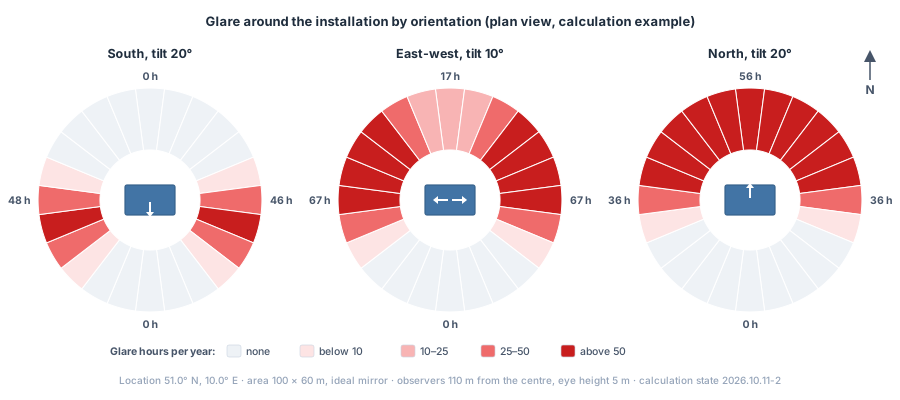
Germany – LAI. The notes of the German Federal/State Working Group on Immission Control (LAI) on light immissions contain recommendations on glare from photovoltaic systems in Annex 2 (as of 3 Nov 2015). As a point of reference for a significant nuisance, the guideline names an astronomically maximum possible glare duration of at least 30 min per day or 30 h per calendar year, taking all surrounding PV systems into account. For modules facing south, according to the LAI, locations mainly west and east of the system up to approx. 100 m away are potentially affected. The distance is a guide value; with large differences in height or extensive systems on a slope, locations further away can also be affected.
Austria – OVE R 11-3. The guideline was formally withdrawn on 1 Dec 2024 and is unofficially often still applied for orientation.
Switzerland – EnergieSchweiz/Swissolar. The guide to the notification and approval procedure for solar systems (edition June 2023) is a non-binding decision aid with reference values for duration and luminance.
None of the three guidelines is a law. Which guideline applies and how it is applied in the individual case is decided by the responsible expert and the competent authority.
Annex 2 of the LAI notes in detail: LAI guidance explained.
What PV-GlareCheck calculates
- every minute of the year with the sun above the horizon, under clear sky,
- glare duration per day and per year, number of days with glare and the glare times by date and time of day,
- luminance and illuminance at the observation point when a module type with a measured reflection profile is selected,
- occlusion by recorded buildings, embankments and vegetation and by the terrain from an elevation model,
- sun overlap and further filters, adjustable per group in the report without a new simulation.
Several storeys of a building are entered as separate groups with their own eye height. Existing neighbouring systems can be added as further PV areas.

Workflow
- Enter the system, buildings and obstacles on the map; elevations from official terrain models where available.
- Use the pre-analysis to check in which directions the system reflects.
- Start the annual simulation.
- Set the filters in the report according to the relevant guideline and export the result as a PDF.
Limits
The simulation is a model-based screening and does not replace an expert report. It assumes a clear sky; cloud cover shortens the real glare duration. The app does not check the location and distance rules of the guidelines automatically, and it does not assess the result.
Next: Settings, filters and a calculated example are described in the manual, chapter VI.1 Residents.
Sources
- Bund/Länder-Arbeitsgemeinschaft für Immissionsschutz (LAI): Hinweise zur Messung, Beurteilung und Minderung von Lichtimmissionen. Resolution of 13 Sep 2012, as of 8 Oct 2012, version with formula correction of 03/2018; Annex 2 „Empfehlungen zur Ermittlung, Beurteilung und Minderung der Blendwirkung von großflächigen Freiflächen-Photovoltaikanlagen im Rahmen von Baugenehmigungsverfahren“, as of 3 Nov 2015.
- OVE Österreichischer Verband für Elektrotechnik: OVE-Richtlinie R 11-3, Blendung durch Photovoltaikanlagen. Edition 2016-11-01, Vienna. Formally withdrawn on 1 Dec 2024 (OVE Standardization News 1/2025, p. 1), unofficially still often used for orientation.
- EnergieSchweiz, Swissolar et al.: Leitfaden zum Melde- und Bewilligungsverfahren für Solaranlagen. Edition June 2023, Bern (predecessor February 2021).