LAI guidance on glare from PV systems
What the LAI notes are
In 2012, the German Federal/State Working Group on Immission Control (LAI) adopted “Hinweise zur Messung, Beurteilung und Minderung von Lichtimmissionen” (notes on the measurement, assessment and mitigation of light immissions). Annex 2, as of 3 Nov 2015, contains recommendations on determining, assessing and mitigating glare from large ground-mounted photovoltaic systems in building permit procedures. The document is published in a version with a formula correction of 03/2018.
Which systems
Annex 2 applies primarily to large ground-mounted systems that require a building permit. According to the LAI, smaller systems on residential and commercial buildings generally do not reach the thresholds; for systems exempt from permits, the annex applies accordingly in exceptional cases.
Relevant receptors
- rooms requiring protection: living rooms and bedrooms, rooms with beds in accommodation, hospitals and sanatoriums, classrooms, offices, practices, workrooms and training rooms,
- terraces and balconies, treated as equivalent to rooms requiring protection during the day between 6:00 and 22:00,
- undeveloped plots on which such buildings are permitted, at 2 m above ground at the most affected edge.
Where glare potentially occurs
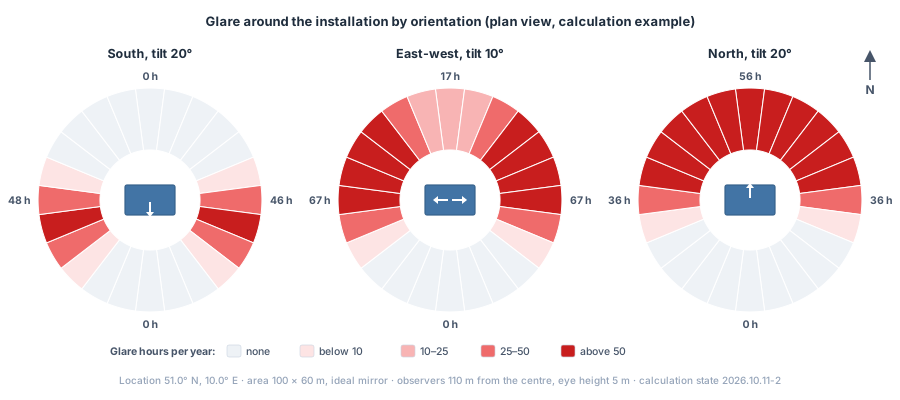
The LAI's location statements refer to systems with modules facing south. Locations mainly west or east of the system that are no more than approx. 100 m away are potentially affected. Locations to the north are usually unproblematic unless they are comparatively high or the modules are tilted very flat; locations to the south only need to be considered for façade systems.
The distance of approx. 100 m is a guide value. With large differences in height or extensive systems, especially on slopes, it no longer applies. For systems with a different orientation, such as east-west or north, the affected locations lie elsewhere.
Calculation model and sun overlap
The LAI assumes a point-shaped sun and an ideally mirrored module: angle of incidence equals angle of reflection. The sun shines every day from sunrise to sunset; the astronomically maximum possible glare duration is determined, and weather is not considered.
If the reflection lies close to the sun, glare from the sun itself predominates. The LAI only counts constellations in which the viewing directions to the sun and to the module differ by at least 10°.
Glare duration per day and year
As a point of reference for a significant nuisance, the LAI names a maximum possible astronomical glare duration of at least 30 min per day or 30 h per calendar year, taking all surrounding PV systems into account. The two conditions are linked by “or”.
Luminance
For orientation, the LAI lists luminances from the surroundings up to the midday sun. Annex 2 contains no luminance or intensity criterion for the assessment; only duration is assessed.
Mitigation
The LAI lists screening by embankments or opaque vegetation up to the height of the module top edge, a changed layout, orientation or tilt, and modules with low reflectance.
Status
The LAI notes are administrative guidance without the force of law. The LAI itself states that the legislator has not set significance limits for light immissions and describes its criterion for PV systems as a first point of reference whose transferability must be justified in the individual case. The assessment of the individual case by the competent authority remains decisive.
How a simulation supports the determination
The glare duration according to the LAI results from the geometry of sun, module area and receptor for every minute of the year. PV-GlareCheck calculates this geometry for every observation point. The module type “Perfect mirror” represents the LAI calculation model; the sun is treated as a disc of 0.53° instead of a point, so each glare phase starts about one minute earlier and ends about one minute later. The report shows the maximum daily glare duration, the annual total, the number of glare days and the glare times by date and time of day; sun overlap can be set as a filter. Buildings, embankments, vegetation and terrain can be entered as occlusion, further systems as additional PV areas.
The app does not check the LAI location rules (direction, distance) automatically, and it does not assess the result. The classification remains with the responsible expert. The simulation is a model-based screening and does not replace an expert report.
Next: Overview of glare on residents; settings and a calculated example in the manual, chapter VI.1 Residents.
Sources
- Bund/Länder-Arbeitsgemeinschaft für Immissionsschutz (LAI): Hinweise zur Messung, Beurteilung und Minderung von Lichtimmissionen. Resolution of 13 Sep 2012, as of 8 Oct 2012, version with formula correction of 03/2018; Annex 2 „Empfehlungen zur Ermittlung, Beurteilung und Minderung der Blendwirkung von großflächigen Freiflächen-Photovoltaikanlagen im Rahmen von Baugenehmigungsverfahren“, as of 3 Nov 2015.