
In brief
In rail traffic, the concern is train drivers, who must recognise the line and the signals. For Germany, the sources evaluated give no requirements of their own; the criteria of the position paper for roads can be applied by analogy. In Austria, OVE R 11-3 states that glare is not permitted at signals and level crossings. This is represented with observation points along the track. We welcome references to further guidelines at info@pv-glarecheck.com.
VI.3.1 Protected interest and typical glare situations
The observer is the train driver. The viewing direction follows the track; the driver must reliably recognise the line and the aspects of semaphore and light signals. A reflection can dazzle the driver like a road user (Ch. VI.2) and can additionally outshine a signal if it comes from the same direction as the signal.
Situations in which disturbing glare can occur:
- lines running parallel or at an angle to a system, with a low sun in the direction of travel,
- signals that appear in front of a PV area as seen by the train driver,
- level crossings, where road traffic is affected as well,
- stations and stops with signals close to roof or façade systems.
VI.3.2 Guidelines at a glance
| FBA position paper (by analogy) | OVE R 11-3 (Austria) | |
|---|---|---|
| Scope | federal trunk roads; railways are not covered | rail vehicle traffic, section 6.2.2 |
| Areas where glare is not permitted | not specified for railways | signals (semaphore and light signals) and level crossings according to ÖBB-DV V2 |
| Relevant field of view | ±30° around the main viewing direction, central ±10° (for roads) | not specified |
| Luminance | not significant at ≤ 30,000 cd/m² | not specified |
| Size of the source | not significant at vertical size ≤ 0.30° outside ±10° | not specified |
| Sun overlap | only at sun elevation ≤ 5° | not specified |
| Eye height | car 1.0 m, truck at least 2.7 m; not specified for train drivers | not specified |
| Signals | not specified | signal aspects must not be affected either by incident reflections or by reflecting surfaces behind the signal |
| In case of doubt | case-by-case assessment | assessment by a railway engineering expert |
The sources evaluated contain no requirements of railway infrastructure companies. RVS 05.06.11 only regulates information and advertising signs near level crossings (section 4.6, p. 12), not PV systems.
VI.3.3 Position paper of the Federal Highway Authority (by analogy)
The position paper applies to federal trunk roads (ch. 1, p. 3) and does not mention railways. Its criteria describe the glare of a vehicle driver looking in the direction of travel and can therefore be transferred to train drivers by analogy:
- relevant field of view ±30° around the main viewing direction, central visual area ±10° (ch. 3, p. 5),
- exclusion criteria luminance ≤ 30,000 cd/m², vertical size ≤ 0.30° outside ±10°, sun overlap at sun elevation ≤ 5° (ch. 3, p. 6),
- calculation for the whole year at a resolution of at most 5 min, module-typical reflection with beam spread (ch. 4, pp. 6–7).
Details are given in Ch. VI.2, section VI.2.3. The justification of sun overlap via the sun visor in the vehicle does not transfer if the train has no comparable visor.
VI.3.4 OVE R 11-3, section 6.2.2 (Austria)
In rail vehicle traffic, glare is not permitted (section 6.2.2, p. 12):
- at signals (semaphore and light signals) for rail traffic,
- at level crossings according to ÖBB-DV V2.
The recognisability of signal aspects at stations and stops must not be affected either by incident light from reflections or by reflecting surfaces behind the signals. In case of doubt, an assessment by a railway engineering expert is required. The guideline has been formally withdrawn but in Austria is unofficially often still applied for orientation (Ch. VI.1).
VI.3.5 Settings in PV-GlareCheck
Note on application. The following settings are conceivable interpretations and examples of application, not a binding implementation. Whether and how a guideline is transferred to railways and correctly applied in the individual case must be verified independently by the user.
VI.3.5.1 Editor
| Setting | Representation | Chapter |
|---|---|---|
| Module type of the PV areas | real module type with measured profile (beam spread), as for road traffic | Ch. 8 |
| Observation points | "Points along a line" on the track, one group per direction of travel; denser before signals and level crossings | Ch. 9 |
| "Height a. GL" | eye height of the train driver; as a rough guide value approx. 2.5 m above the top of rail, the sources evaluated give no value | Ch. 9 |
| Field of view | "Enable and align fields of view along the line"; "H±" 30° | Ch. 9 |
| Signals | separate observation point in front of the signal with the viewing direction towards the signal; evaluation via "Min. gaze axis distance" | Ch. 9 |
| Occlusion | noise barriers, cuttings, structures as obstacles; terrain occlusion | Ch. 10, Ch. 6 |
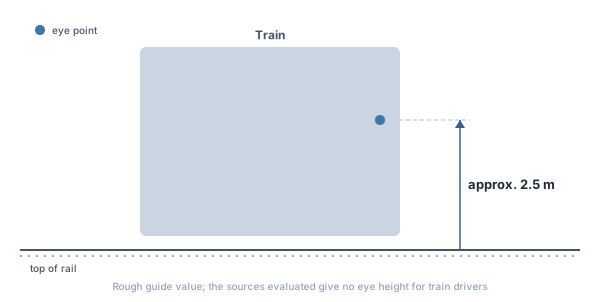
Height reference. The app takes the Ground level from the elevation data (Ch. 6). On embankments, bridges and in cuttings, the terrain differs from the top of rail; jumps in GL between neighbouring points in "Points and heights" indicate this. There, "Calculate GL automatically" can be switched off and the height of the top of rail entered manually.
VI.3.5.2 Possible filter combinations
When the position paper is applied by analogy, one possible filter combination is the same as for road traffic (VI.2.6.2): "Outside field of view" on, "Luminance" ≥ 30,000 cd/m², "Vertical glare source" ≤ 0.3° with "UNLESS" "Distance to gaze axis <" 10° (horizontal), "Sun overlap" with "+ low sun ≤" 5°, geometric filters on. For signals and level crossings, OVE R 11-3 gives no threshold but states that glare there is not permitted. Further filters can be added at the user's discretion where they are professionally justified.
VI.3.5.3 Evaluation quantities
The evaluation quantities correspond to those for road traffic (VI.2.6.3). For signals, "Min. gaze axis distance" is decisive: it shows how close a reflection lies to the viewing direction towards the signal.
VI.3.6 Notes
- Moving observer: each observation point is stationary; the time during which a passing train driver sees a reflection is not reported directly (Ch. VI.2, section VI.2.7.8).
- Vehicle: cab windows, sun protection and window tinting are not modelled.
- Overhead lines and masts act as obstacles only if they are entered.
- Signals: whether a reflection impairs a signal aspect depends on the position, luminance and size of the source relative to the signal. The app provides direction and intensity; it does not assess whether a signal aspect is impaired.
VI.3.7 Sources
- OVE: OVE Guideline R 11-3 "Blendung durch Photovoltaikanlagen", edition 2016-11-01 (withdrawn 2024-12-01), section 6.2.2.
- Fernstraßen-Bundesamt: Eckpunktepapier Photovoltaik – Blendwirkungen und Blendgutachten, as of November 2025.
- Österreichische Forschungsgesellschaft Straße – Schiene – Verkehr (FSV): RVS 05.06.11 Visuelle Störwirkungen, edition 01.12.2011, section 4.6.