
In brief
For residents, what matters is how often and for how long reflections reach living and working rooms, balconies or terraces. The guidelines in Germany (LAI), Austria (OVE R 11-3) and Switzerland (EnergieSchweiz/Swissolar) give reference values for this, in Germany 30 minutes per day or 30 hours per year. These guidelines can serve as orientation; it often makes sense to supplement them with well-founded aspects of the individual case. We welcome references to further guidelines at info@pv-glarecheck.com.
VI.1.1 Protected interest and typical glare situations
For residents, the concern is nuisance to people where they live and work. What is assessed is not a hazard at a given moment but how often and for how long a reflection reaches a protected location. Each guideline defines for itself which locations are protected (see Protected room).
Situations in which disturbing glare can occur:
- residential buildings west or east of a ground-mounted system that receive reflections of the low sun in the morning or evening,
- upper floors, balconies and roof terraces that look over screens or vegetation,
- buildings north of a system if they stand considerably higher or the modules are mounted at a shallow tilt,
- buildings south of a façade system or a steeply tilted area,
- neighbours of a rooftop system with a different orientation, for example a north-facing roof,
- undeveloped building plots on which residential buildings are permitted.
All guidelines covered here consider the astronomically possible case: the sun shines every day from sunrise to sunset, and weather is disregarded.
VI.1.2 Guidelines at a glance
| LAI (Germany) | OVE R 11-3 (Austria) | EnergieSchweiz/Swissolar (Switzerland) | |
|---|---|---|---|
| Edition, status | Annex 2, as of 03.11.2015; enforcement guidance without the force of law | Edition 01.11.2016; withdrawn as of 01.12.2024, unofficially often still applied for orientation | Edition June 2023; non-binding decision aid |
| Immission locations | protected rooms; terraces and balconies from 6:00 to 22:00; undeveloped building land at 2 m height | protected rooms; outdoor areas without time restriction; undeveloped land at the permissible building height | living rooms, schools, hospitals; balconies and garden seating in the summer half-year |
| Location | potentially affected: west or east up to approx. 100 m (modules facing south) | mainly south-west, west, south-east and east; no distance rule | pre-check: more than 100 m distance (residential zone) usually uncritical |
| Calculation model | sun as a point, module as an ideal mirror | sun as a point source, optimal mirrors, beam spread normally not applied | cloudless sky, without beam spread |
| Sun overlap | counted from 10° angle between sun and reflection | counted from more than 10° | counted from more than 20° |
| Reference value per day | 30 min | 30 min (health hazard: 1 h) | 30 min on any number of days, 60 min on at most 60 days, 120 min on at most 20 days |
| Reference value per year | 30 h | 30 h (health hazard: 60 h) | 60 h |
| Combination | day or year | day or year | all four values (reading, see VI.1.5) |
| Intensity | no criterion | no criterion | luminance > 50,000 cd/m², DNI > 120 W/m², power density > 30 W/m² |
| Field of view | not specified | not specified | angle of incidence of the glare ray on the window > 20° |
| Eye height in buildings | not specified | not specified | not specified |
| Time step, minimum sun elevation | not specified | not specified | not specified (indirectly via DNI) |
| Several systems | sum of all surrounding systems | sum of all acting systems | not regulated |
| Weather | excluded | excluded | reference values without clouds |
References are given in sections VI.1.3 to VI.1.5.
None of the three guidelines is a law. The LAI states that the legislator has not issued significance thresholds for light immissions (LAI, p. 2) and calls its yardstick for PV systems "at best a first reference point" whose transferability must be justified in each case (LAI, Annex 2, p. 21). In Swissolar's opinion, the Swiss guide's reference values cannot "currently" be used for assessing building permits or in court proceedings (guide 2023, Annex 1, p. 40).
VI.1.3 LAI (Germany)
Scope. Annex 2 applies initially to large ground-mounted systems that require a building permit. According to the LAI, smaller systems on single-family and multi-family houses and commercial buildings do not as a rule reach the thresholds; for systems exempt from permits, the annex applies correspondingly in exceptional cases (LAI, Annex 2, p. 21).
Relevant immission locations (Annex 2, chap. 3, p. 23):
- protected rooms: living rooms, bedrooms including rooms with beds in accommodation, hospitals and sanatoriums, classrooms, office, practice, work and training rooms,
- terraces and balconies at the building, treated as equal to protected rooms during the day between 6:00 and 22:00,
- undeveloped areas on which buildings with protected rooms are permitted, at a reference height of 2 m above ground at the most affected edge.
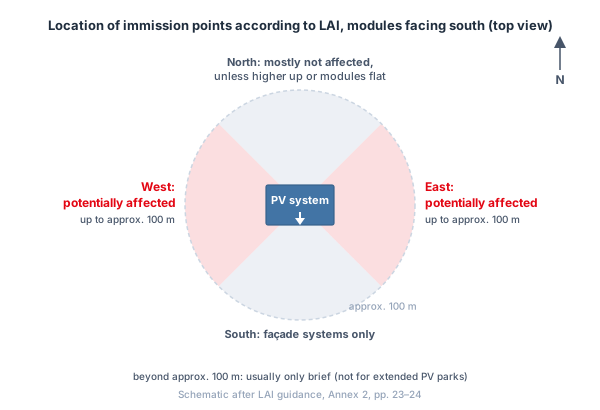
Location. The LAI's statements on location refer to systems facing south (Annex 2, pp. 23–24, figs. 2–5). Potentially affected are locations predominantly west or east of the system that are no more than approx. 100 m away. Locations predominantly north are mostly unproblematic unless they stand comparatively high or the modules are tilted particularly shallowly; locations predominantly south need to be considered only for façade systems. According to the LAI, locations more than approx. 100 m away experience only short glare durations; extensive PV parks are excepted.
The distance of approx. 100 m is a guide value. In unfavourable constellations it no longer applies, for example with large differences in height between the system and the immission location or with extensive ground-mounted systems, especially on slopes. It is therefore recommended to check locations beyond 100 m as a rule; the pre-analysis shows where the system reflects (Ch. 11).
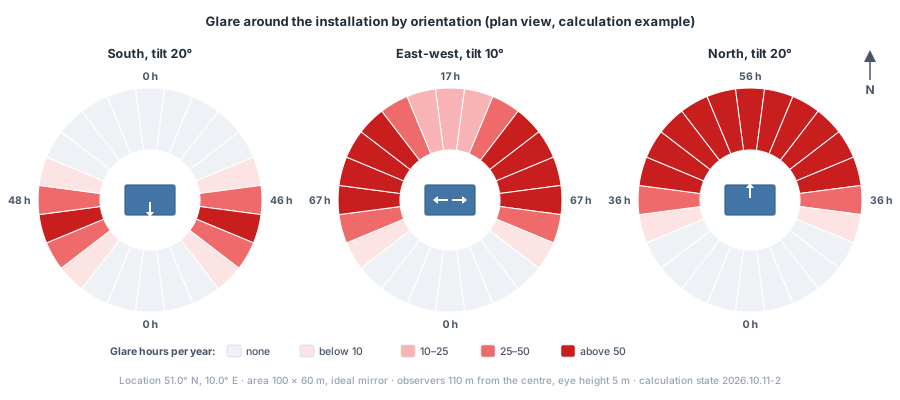
Other orientations. The LAI schematic describes the usual installation with modules facing south. With other orientations the affected locations lie elsewhere. The calculation example below uses the same area in three orientations and counts the glare hours per year for observers all around:
- South, tilt 20°: east and west, as in the LAI; north and south remain free.
- East-west, tilt 10°: east and west as well as north-east and north-west, to a lesser extent also the north.
- North, tilt 20°: the whole north, plus east and west.
South of the area there is no glare in any of the three cases. The figures apply only to this example; for a specific project the pre-analysis (Ch. 11) shows the directions and the simulation the duration.
Calculation model (Annex 2, chap. 4, p. 24): the sun is treated as a point source and the module as an ideal mirror (angle of incidence equals angle of reflection). The sun shines from sunrise to sunset; the astronomically maximum possible glare duration is determined. PV-GlareCheck calculates with point-shaped observation points but with the sun as a disc of 0.53° (Ch. V.3). Compared with the point-shaped sun of the LAI, each glare phase therefore starts about one minute earlier and ends about one minute later: the edge of the sun lies 0.265° ahead of and behind its centre, and the sun moves about 0.25° per minute across the sky. At the edge of the area, occasional short phases are added. The deviation is on the safe side.
Sun overlap (p. 24): at small angles between sun and reflection, glare from the sun itself dominates. Only from a difference angle of approx. 10° does the module cause additional glare; only constellations in which the viewing directions to sun and module differ by at least 10° are counted.
Threshold (p. 24): a significant nuisance may exist if the maximum possible astronomical glare duration, taking all surrounding PV systems into account, is at least 30 minutes per day or 30 hours per calendar year. The two conditions are linked by "or"; 30 h equal 1,800 min.
Luminance. Luminance (cd/m²) describes how bright the reflecting surface itself appears; it does not depend on distance. How much light reaches the observer is described only by the illuminance at the eye (lx): it also depends on how large the luminous surface appears from the observer's position (Ch. V.5). A high luminance on a surface that appears small can therefore bring little light into the eye. For orientation, the LAI quotes the following luminances (Annex 2, pp. 21–22):
| Luminance | Classification according to LAI |
|---|---|
| 10² to 10³ cd/m² | ambient luminance |
| approx. 10⁵ cd/m² | absolute glare occurs; a module reaches this even if less than 1 % of the incident sunlight is reflected towards the immission location |
| 6·10⁶ cd/m² | sun at the horizon |
| up to 1.5·10⁹ cd/m² | midday sun |
Annex 2 contains no luminance or intensity criterion for the assessment; only duration is assessed.
Mitigation (chap. 5, p. 25): screening by embankments or opaque vegetation at the height of the module top edge, changed layout, orientation or tilt, modules with low reflectance.
VI.1.4 OVE R 11-3 (Austria)
The guideline has been formally withdrawn without a successor being issued. In Austria it is unofficially often still applied, at least for orientation.
Scope (chap. 1, p. 4): indirect glare from reflected sunlight in the (residential) neighbourhood and at transport routes, in the planning phase and in the case of complaints.
Relevant immission locations (section 6.1, p. 11): living rooms including halls, bedrooms including accommodation, hospitals and sanatoriums, classrooms, office, practice, work and training rooms, plus terraces, balconies, garden pavilions and sun decks outside residential buildings, without a time-of-day restriction. Undeveloped areas are considered at the building height permitted under building law at the most affected edge. Assessment takes place at the least favourable point of the façade or the residential surroundings (section 4.1, p. 8). The guideline contains no general distance rule like the LAI's 100 m; mainly affected are locations south-west, west, south-east and east of the system (chap. 5, p. 10).
Calculation model (chap. 9, p. 14): sun as a point source, modules as optimal mirrors, beam spread normally not taken into account, weather disregarded. The calculation may be performed at representatively chosen points. The same applies to the solar disc in PV-GlareCheck as for the LAI (section VI.1.3).
Sun overlap (chap. 9, p. 14): glare times are accumulated only if the angle between glare ray and sun as perceived from the immission location exceeds 10°.
Thresholds: a significant nuisance cannot be ruled out if the glare time accumulated over the day from all PV systems acting on the immission point exceeds 30 min, or the annual total exceeds 30 h (section 7.1, p. 13; section 4.1, p. 8). Section 4.1 additionally names a health-hazard limit of 1 h per day or 60 h per year (p. 9).
Luminance. The guideline puts the reflectance of real modules at 1 % to 10 % (p. 10) and absolute glare from about 10⁴ cd/m² (p. 8); nevertheless only duration is assessed.
Presentation of results (section 11.1, p. 15): in tabular form date, start and duration, number of glare days, duration on the least favourable day in minutes and annual total in hours; additionally sun-path or bar charts.
Mitigation (chap. 12, p. 16): change tilt or orientation, shade the line of sight, change the installation site; remedies at the source take priority. The guideline does not consider anti-reflective, structured or prismatic glass a suitable measure.
VI.1.5 EnergieSchweiz/Swissolar (Switzerland)
Legal framework (guide 2023, chap. 8.1, p. 34; Annex 1, p. 38): systems must be low-reflection according to the state of the art (Art. 32a para. 1 let. c RPV); low-reflection does not mean glare-free. Legislation has no reference or limit values for intensity.
Protected interest (p. 39): living spaces, schools and hospitals are relevant at all times, balconies and garden seating areas only in the summer half-year, windowless façades, stairwells and garden paths not at all. The values apply to each single observation point in a residential zone, not to entire areas; in commercial zones at least twice the glare durations are acceptable (p. 41).
Disturbance criteria (table in Annex 1, p. 38). A reflection is considered potentially disturbing if all of the following conditions are met:
| Criterion | Reference value | Rationale in the guide |
|---|---|---|
| angle between sun ray and glare ray | > 20° | below this, the reflection comes from the direction of the sun |
| angle of incidence of the glare ray on the window | > 20° | rays at a shallower angle barely enter the room |
| direct normal irradiance (DNI) | > 120 W/m² | threshold for sunshine |
| power density of the reflected ray | > 30 W/m² | weaker reflections not to be counted as glare |
| luminance of the reflecting surface | > 50,000 cd/m² | value under review, expected to be lowered |
Preliminary check (pp. 39–40): glare is excluded if there is no view of the module fronts, the system is in shadow, geometry excludes reflections towards the location, or only windowless façades are hit. As a rule uncritical are systems below 10 m² (residential zone) or 100 m² (commercial zone), distances above 100 m or 50 m, a ratio of system extent to distance below 1/9, or a viewing angle below 6.5°. Otherwise a calculation is made, with a cloudless sky all year and without beam spread; the guide points out that perceptible glare may last longer because roughened glass scatters light.
Duration reference values for residential zones without clouds (pp. 40–41):
- at most 30 min glare duration on any number of days,
- at most 60 min on at most 60 days,
- at most 120 min on at most 20 days,
- at most 60 h of glare per year.
Cloud cover. The reference values apply without clouds. PV-GlareCheck likewise calculates with a clear sky throughout (Ch. V); result and reference values are therefore based on the same assumption. The app does not offer a reduction for cloud cover. According to the guide, the annual glare duration at a typical location in the Swiss Central Plateau decreases by about half if average cloud cover is taken into account (2023, p. 41).
The guide does not state explicitly how the four items are combined. The February 2021 edition still gave 50 h under item 4 and 1/8 and 7.5° for the preliminary check (guide 2021, Annex 1, pp. 34–35).
Mitigation (p. 41): relocate the system, change tilt or orientation, special solar glass, screening, temporary shading, downsizing or omission.
VI.1.6 Settings in PV-GlareCheck
Note on application. The following settings are conceivable interpretations and examples of application of the guidelines, not a binding implementation. Which guideline applies and how it is correctly interpreted and applied in the individual case must be verified independently by the user.
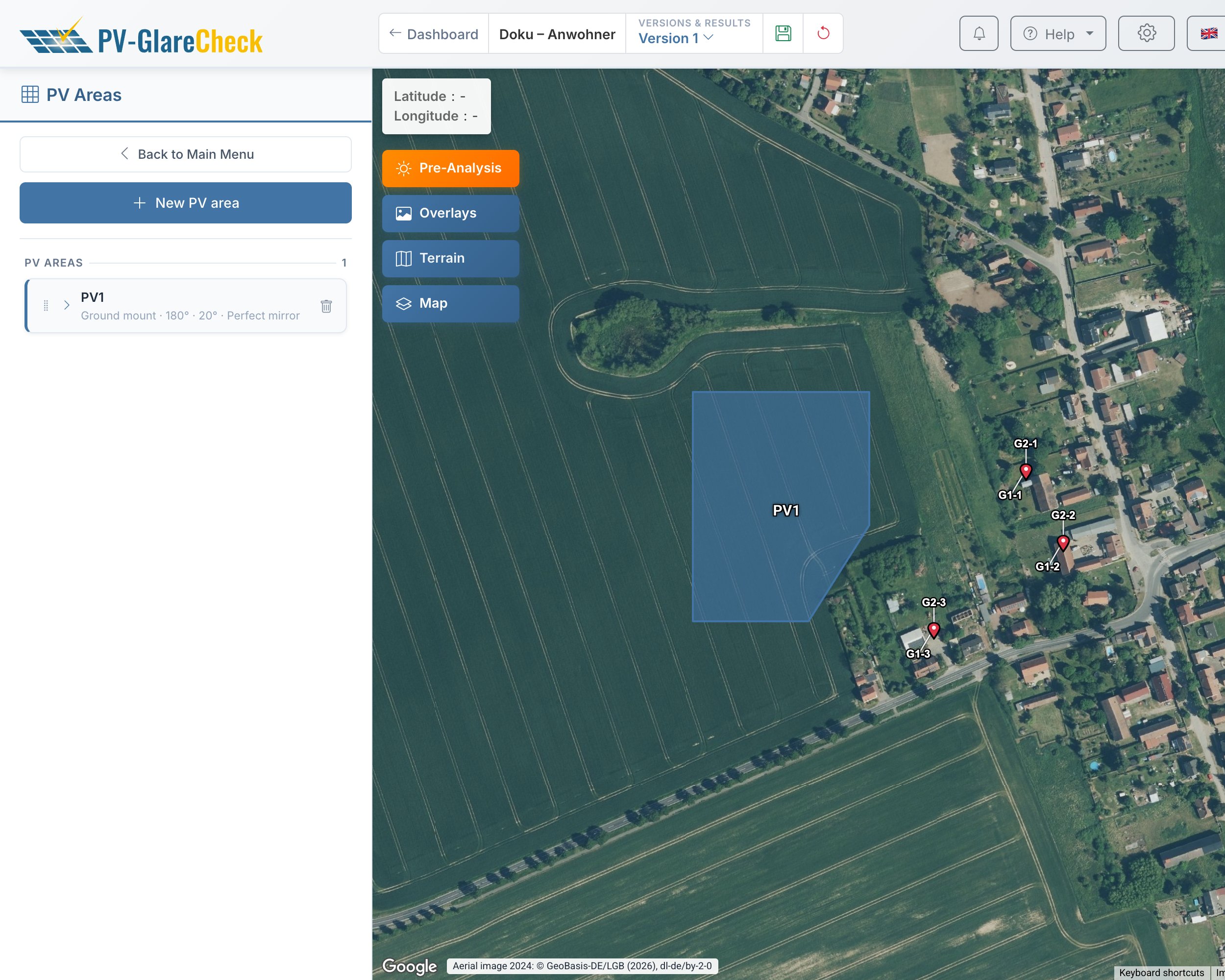
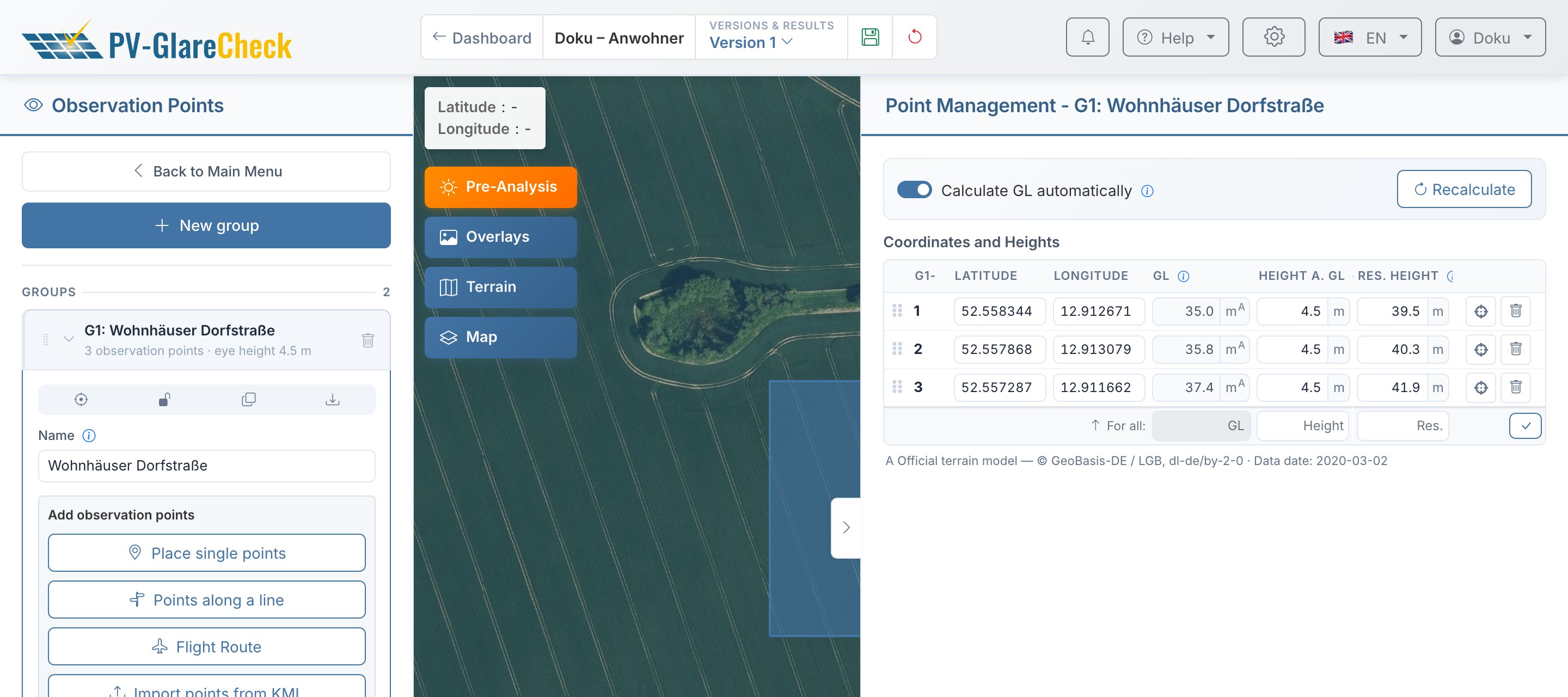
The figures come from an example project near Wernitz (Brandenburg); the PV system is fictitious.
VI.1.6.1 Editor
| Setting | LAI | OVE R 11-3 | Swissolar | Chapter |
|---|---|---|---|---|
| Module type of the PV areas | "Perfect mirror" (core glare) | "Perfect mirror" | duration: "Perfect mirror"; luminance: module type with measured profile in a second run | Ch. 8 |
| Position of observation points | windows of protected rooms, terraces, balconies; undeveloped building land at the most affected edge | least favourable point of the façade or residential surroundings | windows; balconies and garden seating | Ch. 9 |
| "Height a. GL" | eye height per storey; undeveloped land 2 m | eye height per storey; undeveloped land at the permissible building height | eye height per storey | Ch. 9 |
| Field of view | off | off | direction = window normal, "H±" 70°, "V-Ground" and "V-Sky" 70° (approximation) | Ch. 9 |
| Occlusion | buildings, walls, embankments, vegetation as obstacles; terrain via terrain occlusion | as LAI | as LAI | Ch. 10, Ch. 6 |
| Other PV systems | enter as separate PV areas (sum) | enter as separate PV areas (sum) | not regulated | Ch. 7 |
VI.1.6.2 Possible filter combinations
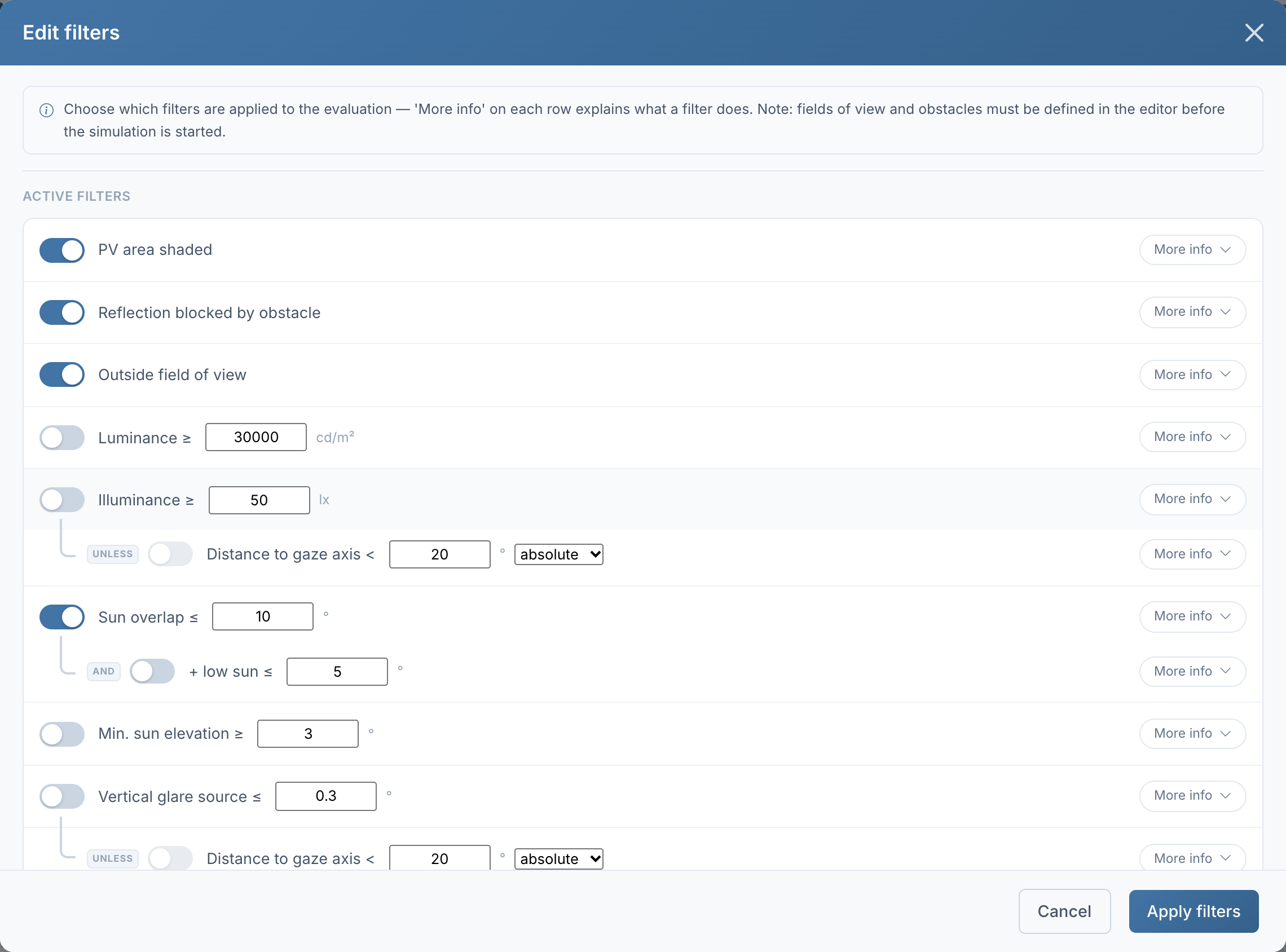
The table shows one possible filter combination per guideline. It lists the filters that can be derived from the guideline, and filters that are switched on in a new report and are switched off for it. Further filters (Ch. V.8) can be added at the user's discretion where they are professionally justified. The filters are set per group in the report under "Evaluation method" with "Edit filters" (Ch. 14, Ch. V.8). "Save as Preset" stores a setting, "Also apply to:" in the dialog transfers them to other groups. The filters change only the evaluation; no new simulation is needed.
| Filter ("Evaluation method") | LAI | OVE R 11-3 | Swissolar 2023 |
|---|---|---|---|
| "PV area shaded" | on | on | on |
| "Reflection blocked by obstacle" | on | on | on |
| "Outside field of view" | no effect (no field of view) | no effect (no field of view) | on (field of view as in VI.1.7.3) |
| "Luminance" ≥ | off | off | 50,000 cd/m² (meaningful only with a real module profile) |
| "Sun overlap" ≤ | 10° | 10° | 20° |
Notes on the table:
- In a new report the "Luminance" filter is switched on at 30,000 cd/m². The LAI and the OVE have no intensity criterion; with "Perfect mirror" the filter has no effect, but it can be switched off for unambiguous documentation.
- "Sun overlap" removes, per PV area, the contribution of a time step in which the angle α between the centre of the sun and the centre of the reflection is at most the set value. This matches the OVE exactly (counted from more than 10°). The LAI counts from 10° inclusive; the difference affects only time steps at exactly 10°.
- The PV area selection under "PV areas" can show the contribution of individual areas. For the sum of all surrounding systems according to the LAI and the OVE, all areas remain included; existing neighbouring systems can be entered as separate PV areas.
VI.1.6.3 Reference values and evaluation quantities
| Quantity in the report | Relation to the guideline |
|---|---|
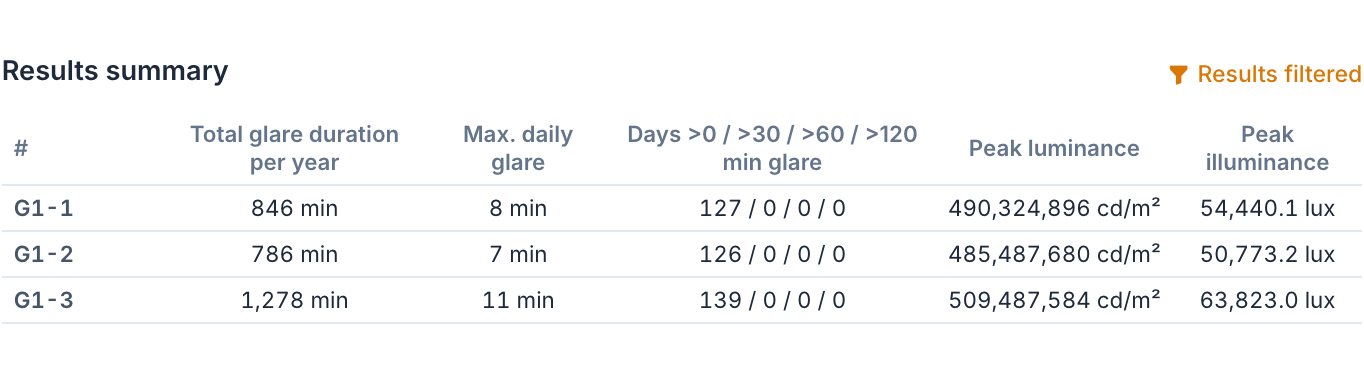
| "Max. daily glare" (min) | LAI ≥ 30 min/day, OVE > 30 min/day, Swissolar staggering 30/60/120 min |
| "Total glare duration per year" (min) | LAI ≥ 1,800 min (30 h), OVE > 1,800 min, Swissolar 2023 at most 3,600 min (60 h) |
| "Days >0 / >30 / >60 / >120 min glare" | OVE: number of glare days; Swissolar: days above 30, 60 and 120 min |
| "Glare times (day × time)" | date, start and duration (OVE 11.1); position in the course of the day (LAI 6:00–22:00 for outdoor areas), position in the year (Swissolar: summer half-year for balconies) |
| "Daily glare duration" | course over the year, comparison with 30 min/day |
| "Peak luminance", "Peak illuminance" | only Swissolar and only with a real module profile |
Glare duration counts each time step once, even if several PV areas reflect at the same time. A dash "—" in the table means that no reflection occurred; "0" means that reflections occurred but were removed by the filters.
One possible reading of the Swiss staggering using the report columns: days above 120 min must not occur, days above 60 min on at most 20 days, days above 30 min on at most 60 days, the annual total at most 3,600 min. The guide does not define this combination.
VI.1.7 Notes
VI.1.7.1 Narrowing down affected buildings
The Pre-analysis ("Reflection Pre-Analysis", Ch. 11) gives an approximate picture of which areas the reflections of the PV areas can reach over the year. The area shown depends on the settings there, such as the "Angle Filter (Reflection Direction)" and the "Min. Sun Elevation". The app does not check the LAI location rules (distance approx. 100 m, compass direction) or the Swiss preliminary check by itself.
VI.1.7.2 Placing observation points
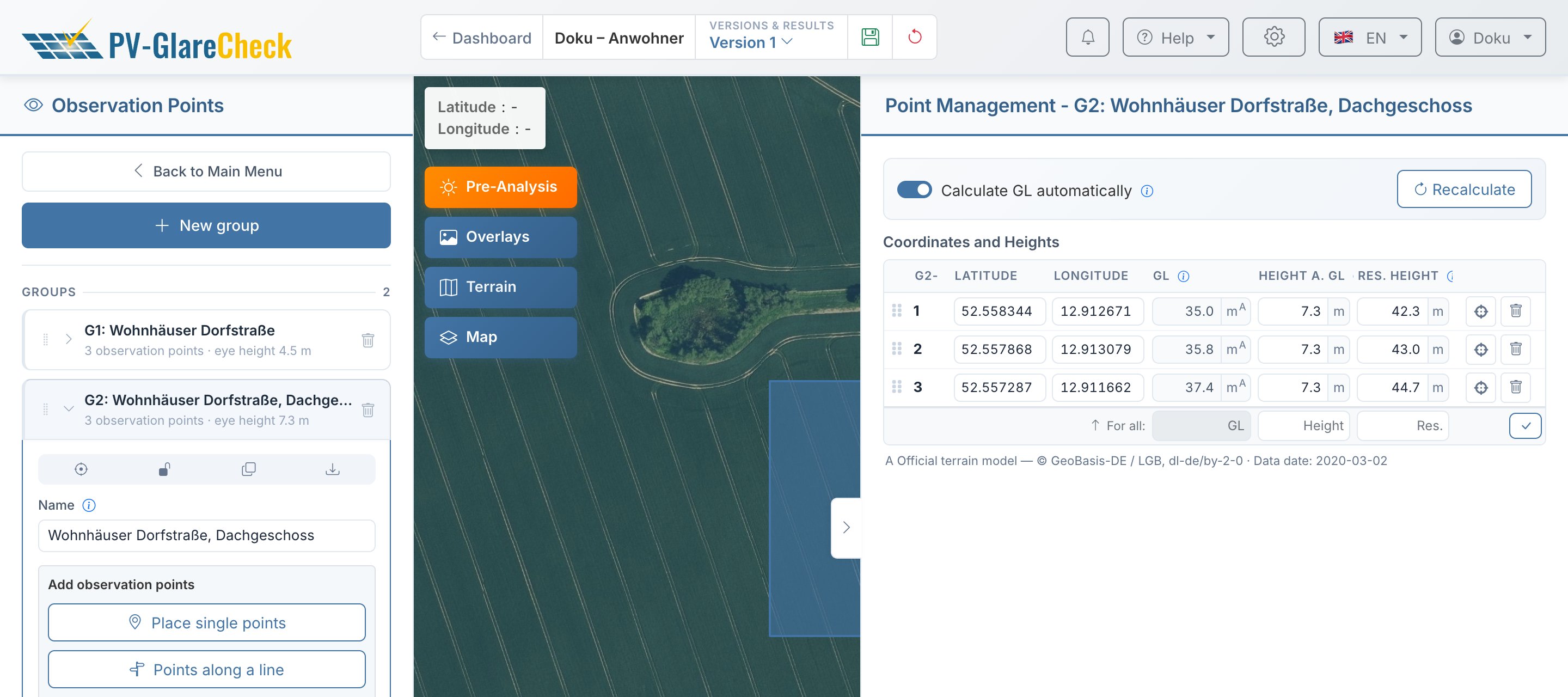
Observation points (Observation point, Ch. 9) belong to groups. Points of a group are filtered and evaluated together in the report. For residents, one group per building, façade or floor can be created ("New group"), with points added via "Place single points", "Points along a line" or "Import points from KML".
- Location: at the windows of protected rooms, at balconies and terraces, each on the side facing the system; according to the OVE at the least favourable point.
- Height: "Height a. GL" is the eye height above Ground level. A value is mandatory for every point; the app sets no default. The floor level goes into the height; the guidelines give no values for it. For undeveloped building plots the LAI gives 2 m above ground, the OVE the permitted building height. In "Points and heights", "For all:" (field "Height") applies one value to all points of the group.
- Several floors: "Duplicate group" creates a copy of the group; in the copy, the height is set for the other floor. Each floor appears as a separate group in the report.
VI.1.7.3 Field of view according to Swissolar
The LAI and the OVE have no field of view. Without an active field of view, the app evaluates all directions (Field of view / FOV, Ch. V.6).
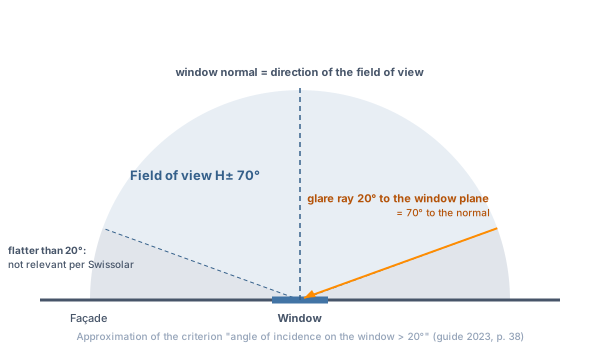
The Swiss criterion "angle of incidence of the glare ray on the window > 20°" can be approximated with a field of view facing out of the window: a ray striking the window plane at more than 20° lies less than 70° from the window normal. In the group's "Fields of View" menu, "Viewing Direction" is set per point to the azimuth of the window normal (looking out of the window), "Tilt" to 0°, "H±" to 70° and "V-Ground" and "V-Sky" to 70°, and the "Active" switch is turned on. The values H±, V-Ground and V-Sky are entered explicitly; the report shows them per point under "FOV parameters".
VI.1.7.4 Occlusion
Buildings, walls, embankments and vegetation between the system and the immission location can be entered as an Obstacle (Ch. 10.1), terrain ridges via Terrain occlusion (Ch. 6). Without this information the app calculates with a free line of sight.
VI.1.7.5 Module type and variants
The module type is selected per PV area in the editor and is therefore fixed before the simulation (Ch. 8).
- LAI, OVE and the duration calculation according to Swissolar assume mirroring modules without beam spread (LAI, Annex 2 No. 4, p. 24; OVE, chap. 9, p. 14; guide 2023, Annex 1, p. 40). This can be modelled with the module type "Perfect mirror": Specular reflection without spread, the reflection has the size of the solar disc (0.53°), and its luminance is that of the sun. Compared with a point sun, the solar disc lengthens each glare phase by about one minute at its start and end (section VI.1.3).
- The Swissolar luminance criterion requires real reflection properties. It can only be checked with a module type that has a measured Module profile. With "Perfect mirror" every reflection has the luminance of the sun; luminance thresholds are then meaningless.
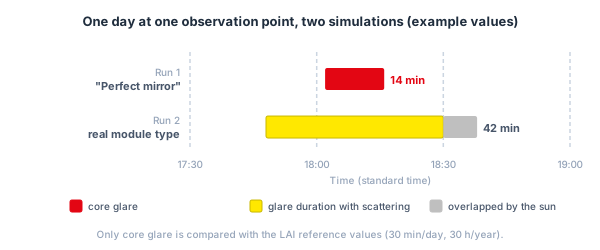
- Real modules reflect with beam spread; the reflection is wider than the solar disc and lasts longer. The Swiss guide itself points out this difference (2023, p. 40).
Both approaches can be calculated side by side as versions, for example via the "Batch Analysis" with the attribute "Module type" (Ch. 13). The glare duration with "Perfect mirror" is often called core glare; the glare duration with a real module type additionally includes scattered reflection and is longer.
VI.1.7.6 Simulation
The simulation calculates a whole year in time steps of 1 min, with a cloudless sky every day (Ch. 12, Ch. V.1). This corresponds to the astronomical approach of all three guidelines. Times in the report are Standard time without daylight saving time.
VI.1.7.7 Limits of the modelling
- Time of day and season: the LAI restriction of terraces and balconies to 6:00–22:00 and the Swiss restriction of balconies to the summer half-year are not available as filters. They can be read from "Glare times (day × time)"; times are standard time.
- Radiation criteria: there is no filter for DNI > 120 W/m² or for the power density of the reflected ray > 30 W/m² according to Swissolar. The app uses clear-sky direct irradiance (Ch. V.1); "Min. sun elevation" is not an equivalent substitute.
- Angle of incidence on the window: the field of view is a rectangle in azimuth and elevation, the Swiss criterion a cone around the window normal. The corners of the rectangle extend further than 70° from the normal; with H± 70° and V 70°, all reflections that meet the criterion are therefore counted, plus reflections in the corners that do not meet it.
- Commercial zones: the doubled glare durations according to Swissolar have no columns of their own; they can be read from "Daily glare duration".
- Two model assumptions in one run: duration without beam spread and the luminance of real modules (Swissolar) cannot be combined in one simulation; two runs are needed.
- Sun overlap with extended sources: the angle α is formed per time step and PV area as the mean over the reflecting regions. With very extended reflections, part of the source may lie closer to the sun than the mean.
- Location and size rules: distance limits, compass directions and the size and angle limits of the Swiss preliminary check are not checked automatically.
- Occlusion: only entered obstacles and the terrain model occlude. Vegetation changes over the year; the app models obstacles identically all year (Ch. VII).
VI.1.7.8 Settings in the report
The report itself documents the settings used (Ch. 14):
- the filters per group as filter cards under "Evaluation method",
- for each observation point the position, terrain height, observer height and, where applicable, the field of view in the chapter "Observation Points",
- module types with their characteristic curves in the appendix,
- version and calculation state on the cover page.
If "Perfect mirror" and a real module type are both calculated, two versions with their own reports are created (section VI.1.7.5).
VI.1.8 Sources
- Bund/Länder-Arbeitsgemeinschaft für Immissionsschutz (LAI): Hinweise zur Messung, Beurteilung und Minderung von Lichtimmissionen, resolution of 13 Sep 2012, as of 8 Oct 2012, Annex 2 as of 3 Nov 2015, formula correction 03/2018.
- OVE Österreichischer Verband für Elektrotechnik: OVE-Richtlinie R 11-3 "Blendung durch Photovoltaikanlagen", edition 2016-11-01; withdrawal: OVE Standardization News 1/2025, p. 1.
- EnergieSchweiz/Swissolar: Leitfaden zum Melde- und Bewilligungsverfahren für Solaranlagen, edition June 2023 (predecessor February 2021).
- EnergieSchweiz: Stand der Technik zu blendarmen Oberflächen bei PV-Modulen (state of the art of low-glare surfaces on PV modules), October 2024 (proposals for revision, not binding).