
In brief
For every minute of the year, the sun position is determined, the light is reflected at the modules, and it is checked whether the reflection reaches the observation point, whether anything blocks the path and how bright it is there. The calculation assumes a clear sky throughout; the glare times are therefore maximum values.
Each step of the calculation chain has its own page (Ch. V.1 to Ch. V.7), followed by filters (Ch. V.8), parameters (Ch. V.9) and sources (Ch. V.10); how the calculation is verified is shown under quality assurance (Ch. D). Formulas, thresholds and edge cases are in the expandable deep dives.
Overview
PV-GlareCheck calculates when and how strongly a PV module surface reflects sunlight in such a way that the reflection reaches an observation point.
A full year is calculated in steps of 1 minute. For every combination of PV area and observation point, every minute passes through the same chain of checks:
1
Sun position (Ch. V.1): Where is the sun, and how strong is the direct irradiance?
2
The installation as seen from the observation point (Ch. V.2): Which part of the module surface is visible from there, and how are the modules oriented?
3
Does the reflection hit the observation point? (Ch. V.3): Does the observation point lie within the reflection lobe?
4
Is the path clear? (Ch. V.4): Does sunlight reach the area, and does the reflection reach the observation point?
5
How bright is the reflection? (Ch. V.5): Luminance of the glare source and illuminance at the eye.
6
Is the reflection within the field of view? (Ch. V.6): Does the glare source lie in the observer's viewing direction?
7
What gets stored (Ch. V.7): every event with time, direction, brightness and visibility attributes.
If a reflection passes the geometric check (step 3), it is stored with all its attributes, even if it is shaded, blocked or outside the field of view. These attributes are only evaluated by the filters in the report (Ch. V.8). Filters can therefore be changed afterwards without re-simulating.
Clear sky. The simulation assumes a clear sky throughout. The reported glare times are therefore the astronomically possible values for the modelled geometry, that is, an upper bound. Clouds, haze, precipitation, soiling or snow reduce the real glare duration; they are not modelled (Ch. VII).
The guidelines for neighbourhoods make the same assumption. The LAI guidance assumes a sun that shines from sunrise to sunset and thus the astronomically maximum possible exposure periods (LAI, Annex 2 No. 4, p. 24). The OVE guideline R 11-3 disregards weather influencing irradiation (section 9, p. 14). The guide by EnergieSchweiz and Swissolar calculates with a cloudless sky all year round and states that, with average cloud cover, the annual glare duration at a typical site in the Swiss Plateau falls by about half (guide 2023, pp. 40–41). Which guideline names which criteria and how they can be represented with the report filters is described in Part VI for each protected subject (Ch. VI.1 to Ch. VI.4).
The reflection model
Real PV modules do not reflect like an ideal mirror. The reflected light spreads into a widened reflection lobe around a reflection direction. At shallow incidence, this direction may deviate from the ideal specular direction (angle of incidence = angle of reflection); the model represents this by an incidence-angle-dependent reflection offset δ.
The lobe is circular or elliptical: almost round at steep incidence, elongated in the plane of incidence at shallow incidence. Within the lobe the luminance is not evenly distributed; it is highest in the centre and falls off towards the edge. The model can represent this fall-off with up to three concentric intensity zones: a bright core around the reflection direction and up to two weaker, wider rings around the same centre.
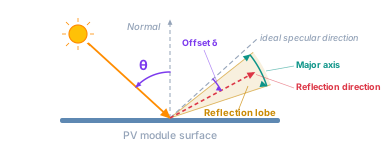
cross-section
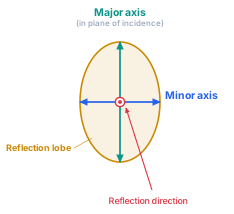
intensity zones
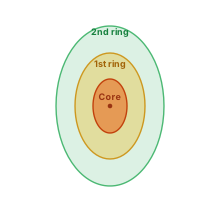
The characteristic curves of a module type
A module profile describes each zone by incidence-angle-dependent curves for luminance, longitudinal and transverse axis; all zones share the reflection offset δ. The curves are stored in 10° steps from 0° to 90° and interpolated linearly. The "perfect mirror" has no curves; the luminance of its reflection equals the luminance of the sun (Ch. V.5). Structure and input of the curves, differences between glass types and the origin of the values are described in Ch. 8, section 8.3.
Perfect mirror and real glass
The perfect mirror in PV-GlareCheck treats the sun as a disc of 0.53°, not as a point. Its hit region is therefore slightly larger than for a point source; the glare duration tends to come out longer. Real glass scatters: the luminance of the reflection falls, its duration increases (OVE R 11-3, section 3, p. 7; guide 2023, p. 40). Measurements on structured and satin glass show that such surfaces can reduce luminance considerably compared with smooth glass (Babin et al. 2022; Toggweiler et al. 2024). How the guidelines model the reflection of the module, and which module type represents that, is summarized in Ch. 8, section 8.6.