
In brief
Filters in the report determine which of the stored reflections count as glare, for example only visible ones, only sufficiently bright ones or only those at a sufficient angle from the sun. They apply per group of observation points and can be changed at any time. Part VI describes for each protected subject which settings correspond to the criteria of the guidelines.
The simulation supplies all geometrically possible reflections, unfiltered. The evaluation is created in the report: there, filters can be switched on, separately for each group of observation points, and changed at any time without a new simulation. "Also apply to:" transfers the settings of one group to others. The settings are saved with the report (Ch. 14).
V.8.1 Two kinds of effect
| Kind | Filters | Effect |
|---|---|---|
| Geometry filters | "PV area shaded", "Reflection blocked by obstacle", "Outside field of view" | remove the affected reflections completely, from the glare duration and from the intensity values; what does not physically reach the observer belongs in no evaluation |
| Assessment filters | "Luminance ≥", "Illuminance ≥", "Sun overlap ≤", "Min. sun elevation ≥", "Vertical glare source ≤" | do not count a time step as glare duration; they represent assessment conventions, not physical impossibility |
Cell by cell. The geometry filters are decided per 0.5° cell. A PV area contributes in a time step only if at least one of its cells passes all active geometry filters at the same time. Luminance, illuminance, vertical extent and distance to the gaze axis then refer only to these cells. Thus no minute can count in which one cell is bright, another is within the field of view and a third is unblocked, without a single cell meeting all conditions at once.
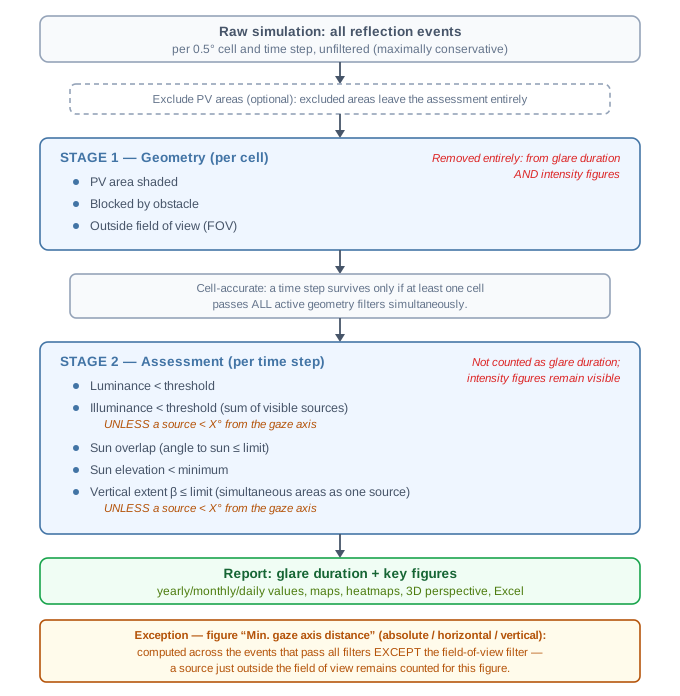
V.8.2 PV area shaded
Removes reflections from cells that are shaded in this time step: by an obstacle between the sun and the cell, by the terrain (with terrain occlusion switched on) or, if activated, because the sun is behind the horizon line of the PV area (Ch. V.4). Default: active.
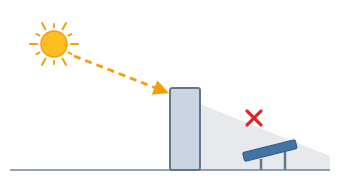
V.8.3 Reflection blocked by obstacle
Removes reflections from cells that are blocked on the way to the observation point by an obstacle or, with terrain occlusion active, by the terrain (more than half of the cell's points). Default: active.
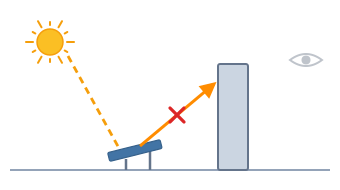
V.8.4 Outside field of view
Removes reflections from cells that lie completely outside the field of view of the observation point (Ch. V.6). Effective only for observation points with an active field of view. Default: active.
V.8.5 Luminance
"Luminance ≥" [cd/m²]: per time step and PV area, the highest luminance of the visible cells is compared with the threshold. If it lies below, this contribution does not count; the time step counts as long as one PV area reaches the value. Default: active, 30,000 cd/m².
For the perfect mirror, every reflection carries the full luminance of the sun; the filter practically never takes effect there.
V.8.6 Illuminance
"Illuminance ≥" [lx]: the illuminance at the eye is assessed as the sum of the visible contributions of all PV areas in a time step. If the sum stays below the threshold, the time step does not count as glare duration. Default: inactive, 50 lx.
Exception "UNLESS Distance to gaze axis <" [°]: if a visible glare source lies closer to the gaze axis than the angle given, the time step counts regardless of the threshold. The reference can be selected: "absolute", "horizontal" or "vertical" (Ch. V.6). The exception only takes effect for observation points with a field of view. Default: inactive, 20°, absolute.
The filter requires simulations from 18.08.2026 onwards; for older ones it is greyed out ("Requires a re-simulation (simulation computed before this filter was introduced).").
V.8.7 Sun overlap
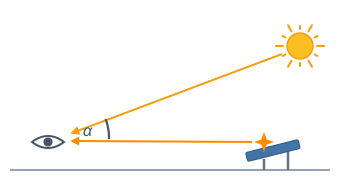
"Sun overlap ≤" [°]: if the reflection appears, from the observer's point of view, in the immediate vicinity of the sun, it is outshone by direct sunlight. The angle α between the centre of the sun and the centres of the 0.5° cells over which a PV area reflects in this time step is assessed, averaged over all these cells; blocked, shaded and out-of-view cells are included. If the mean is less than or equal to the limit, the contribution of this PV area in this time step does not count. Default: inactive, 10°.
"+ low sun ≤" [°] (condition "AND"): restricts the filter to time steps in which the solar elevation is at the same time at most the value given. Selectable only together with sun overlap. Default: inactive, 5°.
V.8.8 Minimum sun elevation
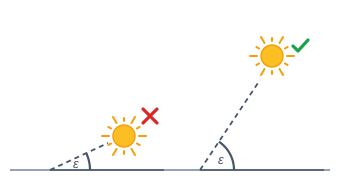
"Min. sun elevation ≥" [°]: time steps in which the solar elevation is below the angle given do not count as glare duration. Without the filter, glare is counted down to the horizon. Default: inactive, 3°.
V.8.9 Vertical glare source
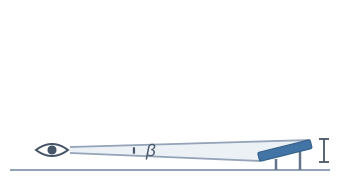
"Vertical glare source ≤" [°]: the vertical angular extent β under which the glaring surface appears to the observer is assessed. If it is less than or equal to the limit, the glare source appears only as a narrow strip, and the time step does not count as glare duration. Default: inactive, 0.3°.
For each azimuth column, the height of the source from its lowest to its highest point is measured; the highest column of the time step is decisive. If several PV areas cause glare at the same time, spans that overlap in the same column or come within 0.1° of each other form one common source; separate spans count individually. If PV areas are excluded in the report, the largest single one of the remaining areas applies, because the common source is formed over all PV areas and stored during the simulation. Only parts that pass the active geometry filters count, so with the field-of-view filter active only parts within the field of view.
Exception "UNLESS Distance to gaze axis <" [°]: as for the illuminance filter. Default: inactive; when switched on 10°, horizontal. Saved filter settings of a report keep their values.
Simulations before 25.09.2026 measured the extent per 0.5° cell and therefore hardly exceeded 0.5°; the column measurement applies after a re-simulation. Combining simultaneously glaring areas into one source applies to simulations from 01.10.2026; older ones evaluate the largest single area.
V.8.10 Excluding PV areas
Under "PV areas", individual PV areas can be taken out of the evaluation for a group of observation points, for example to isolate the contribution of one area or to compare variants. Excluded areas leave the evaluation of this group completely, before all other filters.
V.8.11 Glare duration and figures
The report's outputs are created from the filtered events (Ch. 14):
- Glare duration. The time steps in which at least one reflection remains after all filters are counted, at 1 minute per time step. If several PV areas cause glare in the same minute, the minute counts once. From this arise "Total glare duration per year", monthly and daily values, "Max. daily glare" and "Affected days", as well as the counts "Days >0 / >30 / >60 / >120 min glare" (each more than the duration stated).
- Intensity. "Peak luminance" and "Peak illuminance" refer to reflections that pass the geometry filters.
- "Min. gaze axis distance" (absolute, horizontal, vertical) is calculated over the events that pass all filters except the field-of-view filter. The figure describes how close a source comes to the gaze axis; a source just outside the field of view remains taken into account for it, even if it no longer appears in glare duration and intensity.
The report contains no limit lines, traffic lights or assessment verdicts. Classifying the results against a guideline is the task of the responsible expert (Ch. VI.1 to Ch. VI.4).
V.8.12 Guidelines and filter settings
Which criteria the guidelines name and which filter settings can represent them is described in Part VI for each protected subject, with references:
| Protected subject | Criteria of the guidelines | Possible filter combination |
|---|---|---|
| Residents (Ch. VI.1) | VI.1.3 to VI.1.5 (LAI, OVE R 11-3, EnergieSchweiz/Swissolar) | VI.1.6.2 |
| Road traffic (Ch. VI.2) | VI.2.3 to VI.2.5 (Federal Highway Authority, OVE R 11-3, RVS 05.06.11) | VI.2.6.2 |
| Rail traffic (Ch. VI.3) | VI.3.2 to VI.3.4 (position paper by analogy, OVE R 11-3) | VI.3.5.2 |
| Air traffic (Ch. VI.4) | VI.4.3 to VI.4.5 (EASA CS-ADR-DSN, FAA, further guidelines) | VI.4.6.7 |
The mapping describes capabilities of the app, not conformity with a guideline.